GEO Is Not Just SEO In Disguise
Does strong SEO performance ensure visibility in AI search? If not, who is losing out?

Gwen Sawicki, Research Assistant, Gumshoe

Nick Clark, Research Engineer, Gumshoe
- AI citations analyzed
- 65M+
- Domain categories
- 12+
- SEO-GEO correlation (R²)
- 0.008
Watch a Video Breakdown
Key Findings
There is ongoing debate whether GEO simply depends on SEO. The argument is that since AI search systems rely on external search providers for source retrieval, SEO is the primary driver of AI citation. On the other hand, prior work has found that strong GEO results require optimizing for a distinct set of model-specific preference rules (Wu, 2026).
We argue it is important to measure your brand's visibility in AI search in addition to your SEO performance. With access to over 65 million AI citations, we assessed the extent to which domain authority is correlated with AI citation rates.
SEO is a poor predictor of AI visibility. Pinterest, Alibaba, Lowes, and WordPress all underperform in AI search relative to their domain authority, indicating SEO does not guarantee AI visibility.
Some domains punch well above their SEO weight. YouTube, Reddit, Quora, Wikipedia, and Business Insider are substantially overrepresented in AI citations relative to their organic search scores.
The disconnect is sharpest for ecommerce and business. In these categories, SEO score and AI citation rate show a pronounced negative relationship, making SEO an especially unreliable proxy for GEO performance.
Methodology
We defined SEO and GEO scores to represent how visible a brand is in traditional search and in AI-generated results, respectively.
SEO Score
The SEO score measures a domain's organic search visibility using SERP rank data. For each domain, we counted the number of appearances in position buckets from a dataset of scraped SERP results.
SEOscore = log 12 ∑ i=1 1 log2(xi + 1) + 1
where xi is the number of appearances in the i-th position bucket
GEO Score
The GEO score was calculated using Gumshoe's AI citation data and normalized for report run frequency to account for uneven distribution of product categories in our dataset.
GEOscore = ctot2 rruns + 1
where ctot is the total citation count and rruns is the number of Gumshoe report runs where the domain appeared as a competitor
Both scores were then min-max normalized to a range of [0, 100].
What We Found
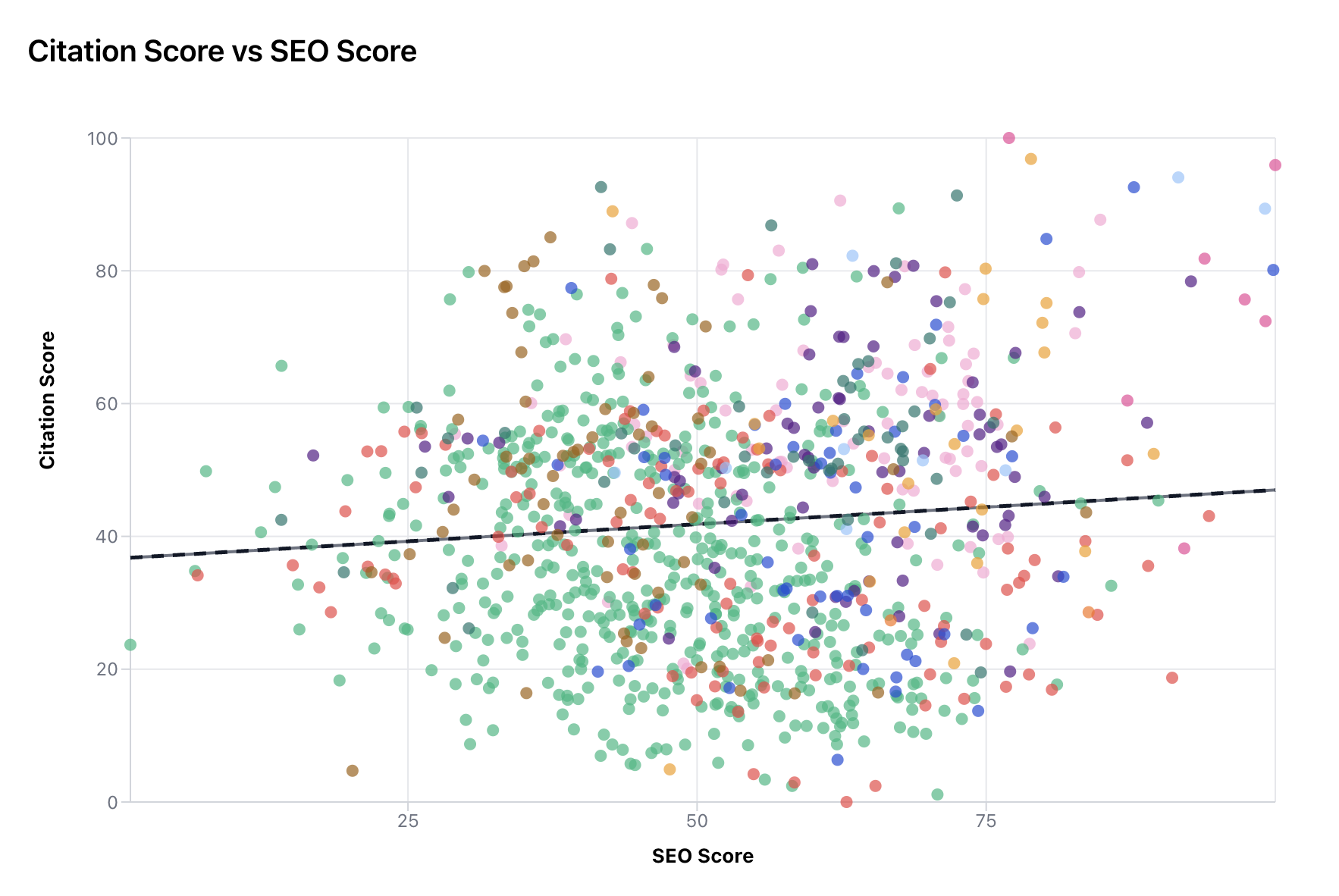
Modeling the linear relationship between GEO scores and SEO scores, a very slight positive trend emerges. However, the relationship is extremely weak, as evidenced by an R² value of 0.008. Practically, the SEO score of a domain is a very poor predictor of its AI citation performance.
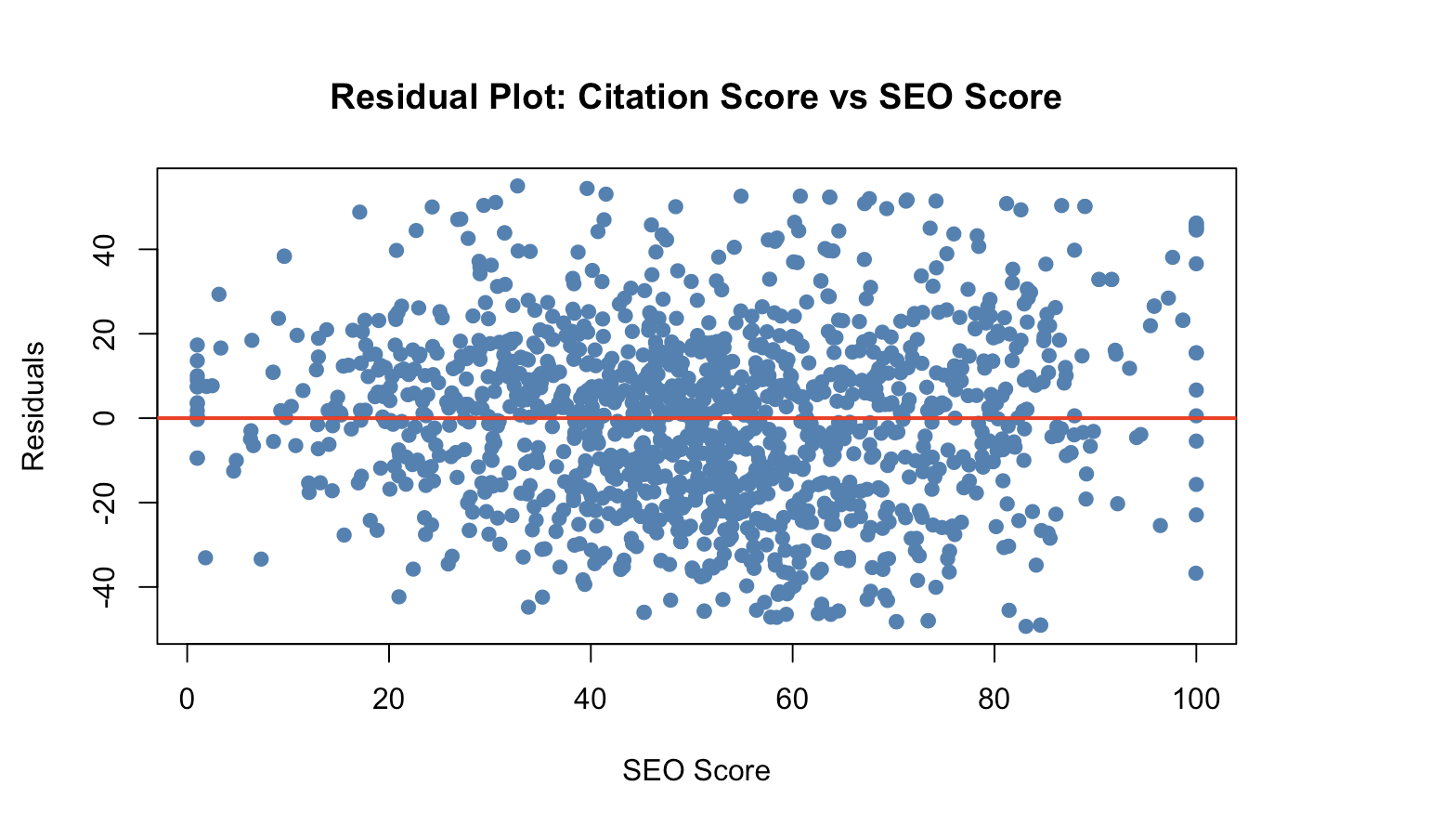
The lack of relationship between the SEO and GEO scores is also evident in the residuals. Throughout the plot, residuals are randomly scattered, suggesting that a variety of GEO rankings are present across both high and low SEO scores. The slight widening around SEO scores of 20 points to a certain level of SEO score being needed before high citation scores become possible, but even at very high SEO scores, GEO performance varies widely.
Biggest Losers and Winners
Some well-known brands performed poorly in GEO metrics relative to their SEO scores and others in the same category. These are illustrative examples of relative underperformers, not a ranked list of the worst overall performers.
↓ Poor Performers
pinterest.com
Social Networks
wordpress.com
Blogs/Content
lowes.com
Ecommerce
allrecipes.com
Blogs/Content
alibaba.com
Ecommerce
↑ Strong Performers
quora.com
Forums/Community
reddit.com
Forums/Community
wikipedia.org
Educational
businessinsider.com
News/Media
youtube.com
Forums/Community
A Closer Look at Ecommerce and Business
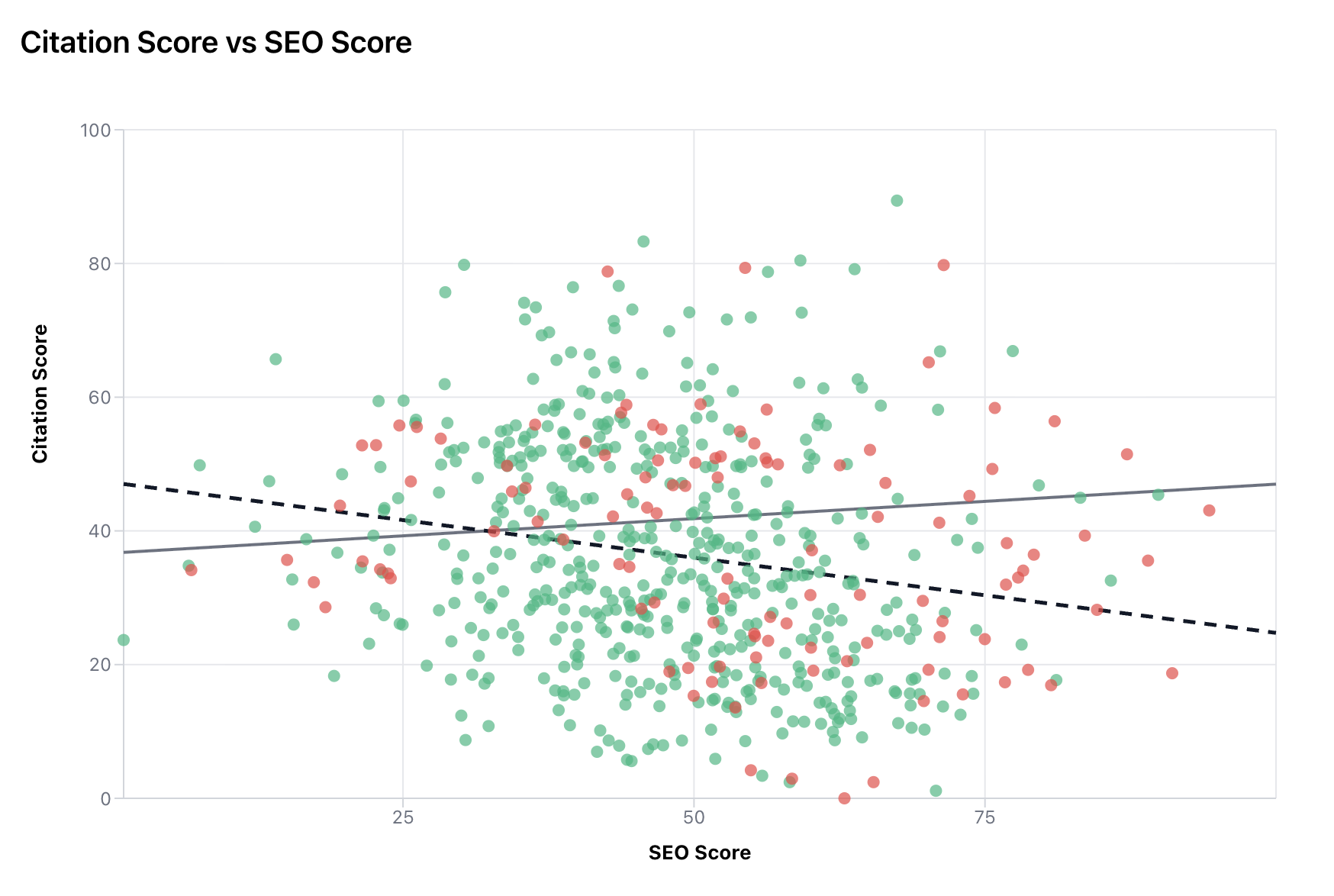
Two domain categories that stood out were Ecommerce (red) and Business (green) as they had a pronounced negative relationship between GEO and SEO scores, although the strength of this relationship was poor (R² = 0.038). So, for business and ecommerce websites, strong SEO is not a reliable predictor of GEO performance.
Why This Matters
Prior analyses have shown that AI models prioritize a distinct set of content signals when assessing credibility (Pfrommer, 2024). This work corroborates those findings by highlighting a weak relationship between SEO and AI citation rates.
One limitation is that we consider only the effect of domain authority on citation frequency, which excludes domains that are never cited. It is plausible that some minimal SEO threshold is necessary to appear in AI results, but beyond that, other factors dominate. Understanding these signals is key for improving brand visibility as AI emerges as a more personalized substitute for traditional search engines (Aggarwal, 2024).
The practical implication is direct: brands that rely solely on their SEO ranking as a proxy for AI visibility are flying blind. Ecommerce and business brands in particular face a real risk of strong SERP performance masking poor AI citation rates.
Ready to measure your own AI visibility? See how your brand appears across AI search engines, broken down by model, persona, and category.
References
Aggarwal, P., Murahari, V., Rajpurohit, T., Kalyan, A., Narasimhan, K., & Deshpande, A. (2024, August). GEO: Generative engine optimization. In Proceedings of the 30th ACM SIGKDD conference on knowledge discovery and data mining (pp. 5–16).
Pfrommer, S., Bai, Y., Gautam, T., & Sojoudi, S. (2024, November). Ranking manipulation for conversational search engines. In Proceedings of the 2024 Conference on Empirical Methods in Natural Language Processing (pp. 9523–9552).
Sawicki, T. (2026, June). What the average hides: AI brand visibility analysis. Gumshoe. https://gumshoe.ai/resources/whitepapers/ai-brand-visibility-analysis/
Wu, Y., Zhong, S., Kim, Y., & Xiong, C. (2025). What generative search engines like and how to optimize web content cooperatively. arXiv preprint arXiv:2510.11438.
Ready to see your own data?
Run a persona-level AI visibility report across ChatGPT, Gemini, Claude, Perplexity, and more.
Free to start · No credit card required