What the Average Hides
Brand visibility across AI models and audience personas, and why the headline number is only half the story.
By Todd Sawicki, Co-Founder & CEO, Gumshoe · June 2026
- Brands analyzed
- 1,145
- AI answers studied
- 602,522
- Models tested
- 13
- Buyer personas
- 7,475
Executive Summary
The single most common question in AI visibility is "what's our score?" It is the wrong question. A single average number hides more than it reveals. Our study of 1,145 brands and more than 600,000 AI answers shows that the standard deviation across brands (26.8 points) is larger than the mean (24.8 points). Visibility is not low on average. It is bimodal. Brands are either well-covered or nearly absent, with very little middle ground.
More important: even within a single brand, visibility varies by as much as 74 percentage points depending on which buyer persona is asking. Lululemon averages 64% overall, but drops to 7.5% for one persona and reaches 81.2% for another. That 74-point swing is not noise. It is the signal most brands are averaging away.
Across all 13 AI models tested and all 1,145 brands analyzed, the pattern holds: persona-level variation is the most important dimension of AI visibility, it is brand-specific, and it cannot be recovered from an aggregate number.
Methodology
This analysis draws on data collected by Gumshoe across 1,145 brands and 602,522 AI answers. For each brand, Gumshoe generated a set of buyer personas grounded in real purchase situations, not demographic labels, but detailed profiles capturing motivations, evaluation criteria, and behavioral signals. In aggregate, the study covers 7,475 unique personas across all brands.
Each persona was used to prompt 13 AI models (GPT-5.4 mini, GPT-5.4, GPT-5.5, Claude Sonnet 4.6, Claude Opus 4.7, Gemini 3 Flash, Gemini 3.1 Pro, Grok 4, Grok 4.3, DeepSeek Chat, DeepSeek Reasoner, Perplexity Sonar, and Google AI Overview) with queries reflecting natural buyer research behavior. Visibility is measured as the percentage of AI conversations in which a brand was mentioned. In total, 602,522 AI answers were analyzed.
Brands are grouped into four visibility tiers (Invisible, Low, Mid, High) and tagged by industry vertical. Product focus specificity is measured by the number of words in the stated focus area submitted to Gumshoe at report creation time.
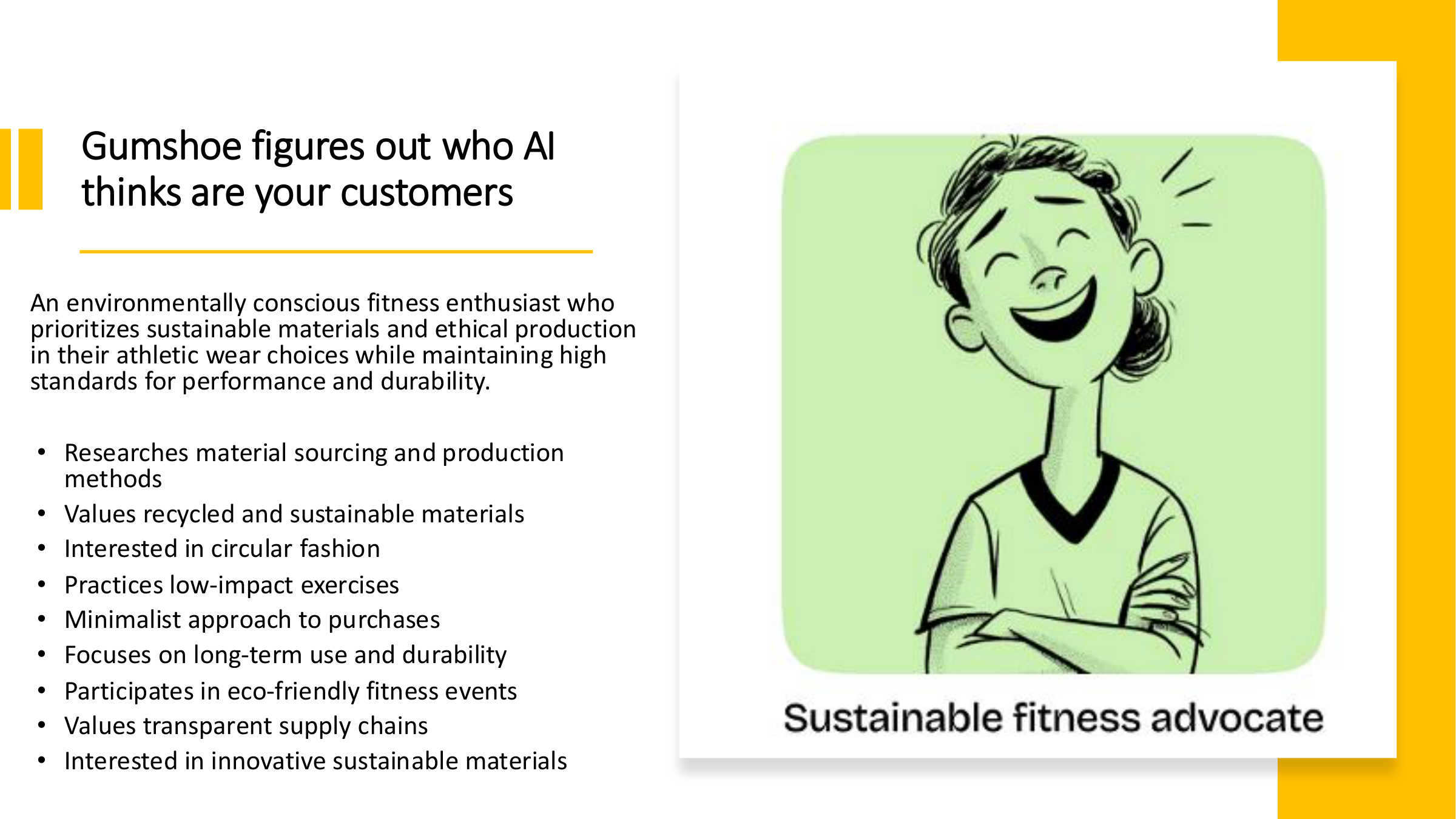
Example persona
Sustainable fitness advocate
An environmentally conscious fitness enthusiast who prioritizes sustainable materials and ethical production in their athletic wear choices while maintaining high standards for performance and durability.
- Researches material sourcing and production methods
- Values recycled and sustainable materials
- Interested in circular fashion
- Practices low-impact exercises
- Minimalist approach to purchases
- Focuses on long-term use and durability
- Participates in eco-friendly fitness events
- Values transparent supply chains
- Interested in innovative sustainable materials
Your personas are busy chatting with AI Models
Hybrid Workout Enthusiast asks:
"Which brands have the best app integration for their workout clothes?"
Perplexity AI Sonar Recommends: Gymshark
"Gymshark ranks first because its dedicated app is built around apparel..."
The Headline
Brands surface in roughly 1 in 4 AI answers, but the visibility spread is enormous
visibility
across 1,145 brands
Why it matters. The standard deviation (26.8) is larger than the mean (24.8). Visibility isn't "low on average." It's bimodal: brands are either well-covered or nearly absent, with little middle ground. A single average hides which side a brand is on.
Visibility Tiers
Visibility spread peaks in the middle
| Visibility tier | Brand reports | Avg visibility | Avg spread σ | Median σ |
|---|---|---|---|---|
| Invisible (0%) | 238 | 0.0% | 0.0 | 0.0 |
| Low (>0 to <30%) | 582 | 10.1% | 6.9 | 5.0 |
| Mid (30 to 70%) | 330 | 48.8% | 15.9 | 14.7 |
| High (>70%) | 121 | 82.6% | 9.5 | 7.9 |
σ = persona spread
Invisible brands (238) have zero persona spread. Spread then peaks in the mid tier (σ 15.9).
Takeaway. 238 brands are invisible to every persona, a different problem from the mid tier (330), where a brand wins with some audiences and loses with others. That mid tier is where persona targeting moves the outcome.
Deeper Dive #1
Personas aren't universal and vary brand to brand
Persona archetype varies a LOT between brands
Every archetype lands within ±2 points of its own brand's average. The dramatic swings (Lululemon's 8% to 81%) are brand-specific, not "this persona type always loses."
Mild tilt: convenience and ease-of-access personas get mentioned slightly more; premium, sustainability and discerning personas slightly less.
Diagnose visibility per brand, not by generic persona archetype.
Lululemon: a 64% average that ranges from 8% to 81%
across all brands
The Lululemon data makes the point precisely. The Sustainable Fitness Advocate collapses to 7.5% while other personas exceed 70%. That gap is not a generic archetype pattern. It is brand-specific and only shows up when you run persona-level analysis against this specific brand.
The takeaway is operational: generic persona benchmarks are not actionable. Visibility must be diagnosed per brand, not inferred from category-level patterns.
Deeper Dive #2
Every model shows visibility is dependent on Personas
Gap between a brand's best- and worst-served persona, averaged per model
Personas aren't noise, every model uses them
All 13 models
shift their answers by 21 to 40 points depending on who is asking. Not one model is persona-blind.
Why Gumshoe: a single blended score averages this away. Gumshoe is the only platform that runs every model as real buyer personas, so you see the variation each model actually shows your customers.
Deeper Dive #3
Which kinds of brands win?
Visibility is not evenly distributed across industries. Auto, Sports & Outdoor leads at 48.8%, followed by Education & Nonprofit (44.9%) and Apparel, Beauty & Jewelry (34.7%). At the other end, Home, Real Estate & Construction (18.2%) and Professional & Business Services (18.9%) trail significantly.
Avg visibility by industry
Green = above average · Red = below average
B2C vs B2B
Consumer brands beat business brands by 8.5 points.
It's a coverage effect: AI surfaces what the web discusses. Consumer categories get reviews and listicles; B2B, local services, and SaaS don't. The gap is what GEO content closes.
Deeper Dive #4
Visibility analysis depends on how you set them up
Avg visibility by number of words in the product focus (1,114 reports)
Measure "Yoga Apparel," not just "Lululemon."
Specific beats broad
17.8% median vis, specific foci (3+ words)
10.6% median vis, broad head terms (≤2)
Broad = crowded field: "GRC platform," "Men's Grooming," "Organic Tea" → brand invisible.
Narrow = ownable: "Marketing for AV Integration Businesses" → OneFirefly 89%; "Mortgage for First-Time Homebuyers" → Better 84%.
WHAT TO TAKE AWAY
Six things the average won't tell you
Brands don't have one score, they have many
With σ (26.8) > mean (24.8), brands are either covered or invisible. Report the distribution, never just the average.
Variability between Personas exists across all tiers
Brands at 30 to 70% swing widest across personas (σ 15.9). That's where persona targeting moves the needle.
Every Brand is unique. Personas vary between each of them
No motivation type is off by more than ±2 pts. Visibility gaps are brand-specific and must be diagnosed per brand.
Every model is persona-sensitive
All 13 models shift answers 21 to 40 pts by persona. Only persona-level testing captures how AI talks to your buyers.
Size & footprint drive visibility
Invisible brands are mostly micro/early-stage; B2B vs B2C is a weak secondary factor. Coverage is what AI rewards.
Scope to winnable product spaces
Specific foci (3+ words) earn 17.8% median vis vs 10.6% for broad head terms. Measure the product, not just the brand.
Found this useful?
Share this report with a colleague who tracks AI visibility.
See where your brand actually stands
Run a persona-level AI visibility report across ChatGPT, Gemini, Claude, Perplexity, and more. Know which buyers AI talks to and which it ignores.
Free to start · No credit card required